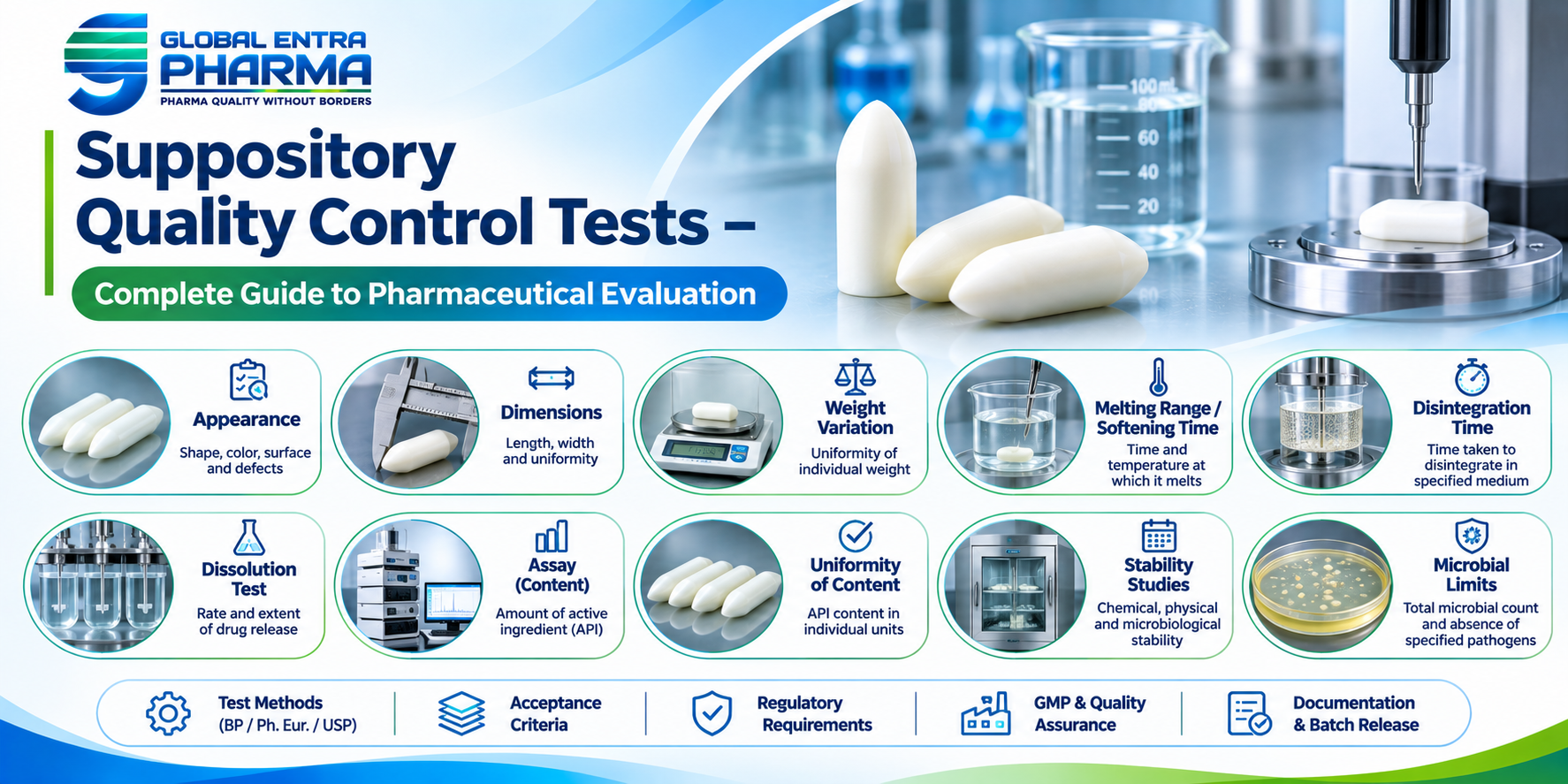
Suppository Quality Control Tests – Complete Guide to Pharmaceutical Evaluation
Introduction to Suppository Quality Control
Quality control is an essential part of pharmaceutical suppository manufacturing. It ensures that every finished product meets its approved specifications for identity, strength, quality, purity, physical characteristics and performance.
Suppositories are solid dosage forms designed to melt, soften or dissolve after administration, depending on the type of base used. Their quality depends on several formulation and manufacturing factors, including the active pharmaceutical ingredient, suppository base, mixing conditions, mould filling, cooling process and packaging materials.
Quality control testing is performed at different stages of manufacturing, from raw material evaluation to in-process checks and finished-product testing.
Rectal suppositories and vaginal suppositories may have different product-specific testing requirements. Therefore, the selection of tests and acceptance criteria should be based on the applicable pharmacopoeia, approved product specifications and regulatory requirements.
1. Appearance and Physical Inspection
Appearance testing is one of the basic quality control tests performed on pharmaceutical suppositories.
The purpose is to check whether the finished dosage form has an acceptable physical appearance and is free from visible defects.
Parameters generally examined include:
-
Shape and dimensions.
-
Colour uniformity.
-
Surface smoothness.
-
Cracks or fractures.
-
Deformation.
-
Air bubbles.
-
Surface irregularities.
-
Leakage or filling defects.
-
Foreign particulate matter.
Suppositories should have a consistent appearance according to their approved product specifications.
Visual inspection can help identify problems associated with improper cooling, mould filling, formulation preparation or handling.
2. Uniformity of Mass Test
Uniformity of mass is an important test used to evaluate the consistency of individual suppository weights within a batch.
During manufacturing, variations in filling quantity may result in differences in the mass of individual units.
The test generally involves weighing individual suppositories and calculating the average mass.
Basic procedure:
-
Select the required number of suppositories according to the applicable method.
-
Weigh each individual unit.
-
Calculate the average mass.
-
Determine the deviation of individual units from the average.
-
Compare the results with the applicable pharmacopoeial or approved specification.
The test helps assess the consistency of the mould-filling operation.
Acceptance limits should be taken from the applicable pharmacopoeial requirements rather than applying one universal limit to every suppository product.
3. Content Uniformity Test
Content uniformity evaluates whether individual suppositories contain the intended quantity of active pharmaceutical ingredient.
A batch may show acceptable weight uniformity but still have variation in drug content if the API is not distributed evenly throughout the formulation.
This is particularly important for formulations in which the API is suspended rather than dissolved in the suppository base.
General testing approach:
-
Select individual units according to the applicable method.
-
Extract the API using a suitable analytical procedure.
-
Analyse the individual samples using a validated method.
-
Calculate the amount of API present in each unit.
-
Evaluate the results against the approved acceptance criteria.
HPLC or another suitable analytical technique may be used depending on the API and formulation.
Content uniformity requirements depend on the applicable pharmacopoeia and product specification.
4. Assay of Active Pharmaceutical Ingredient
Assay testing determines the amount of active pharmaceutical ingredient present in the finished suppository formulation.
It confirms whether the product contains the required drug concentration or strength.
For example, a suppository labelled as containing a specified strength of an API must meet the approved assay specification.
Common analytical techniques include:
-
High-Performance Liquid Chromatography (HPLC).
-
UV-Visible Spectrophotometry.
-
Other validated analytical methods suitable for the API.
HPLC is frequently used when a selective and accurate analytical method is required, particularly for formulations containing multiple ingredients or potential interfering substances.
The assay method should be validated or verified as appropriate for its intended use.
5. Disintegration Test
Disintegration testing evaluates the ability of a suppository to break down or lose its original structure under specified test conditions.
The behaviour depends on the type of suppository base.
For example:
-
Lipid-based suppositories generally soften or melt under suitable conditions.
-
Water-soluble bases may dissolve or disperse in the test medium.
-
Glycerinated gelatin formulations may dissolve gradually.
The test is performed using an appropriate method under controlled conditions.
Disintegration behaviour should not automatically be considered equivalent to drug release or clinical performance. Where required, additional performance testing may be necessary.
6. Dissolution or Drug Release Testing
Dissolution or drug release testing evaluates how the active ingredient is released from the suppository formulation under defined experimental conditions.
The test may be particularly relevant when formulation composition or base characteristics can influence drug release.
Factors affecting drug release include:
-
Type of suppository base.
-
API solubility.
-
Particle size.
-
Drug-base interaction.
-
Formulation composition.
-
Test medium.
-
Temperature.
-
Agitation conditions.
The analytical method and test conditions should be appropriate for the formulation and supported by product development data.
Dissolution or drug release testing should be performed when required by the applicable product specification or regulatory expectations.
7. Melting Range and Softening Characteristics
Melting and softening characteristics are important physical properties of suppositories, especially those prepared using lipid-based bases.
The test helps evaluate how the formulation behaves under controlled temperature conditions.
Important considerations include:
-
Melting behaviour.
-
Softening temperature.
-
Physical consistency.
-
Batch-to-batch variation.
-
Effect of storage conditions.
The melting characteristics of a formulation can influence its handling, storage and performance after administration.
The test method should be selected according to the type of base and the relevant product specification.
8. Liquefaction Time Test
Liquefaction time evaluates the time required for a suppository to reach a specified liquefied or softened state under defined testing conditions.
It is relevant for certain formulations where the physical transformation of the dosage form is an important quality characteristic.
The result may be influenced by:
-
Base composition.
-
Melting or softening characteristics.
-
API concentration.
-
Excipients.
-
Manufacturing conditions.
-
Test temperature.
The test conditions and acceptance criteria should be established using the applicable pharmacopoeial method or approved product specification.
9. Breaking Strength Test
Breaking strength evaluates the mechanical strength of a suppository.
The test helps determine whether the finished units can withstand normal handling, packaging, transportation and storage without breaking or deforming.
Factors influencing breaking strength include:
-
Base composition.
-
Formulation consistency.
-
Cooling conditions.
-
Storage temperature.
-
Manufacturing process.
The test may be useful during formulation development and stability evaluation, particularly when physical integrity is important for the finished product.
10. Moisture Content and Water Content Testing
Moisture or water content testing may be important for certain suppository formulations, particularly those containing hydrophilic bases or moisture-sensitive ingredients.
Excess moisture or changes in water content may affect:
-
Physical consistency.
-
Stability.
-
Microbial quality.
-
Dissolution characteristics.
-
Product appearance.
Suitable analytical methods may include Karl Fischer titration or other appropriate techniques, depending on the formulation.
Testing requirements should be based on the product's composition and stability characteristics.
11. Microbial Limit Testing
Microbiological quality is an important consideration for pharmaceutical suppositories.
The applicable microbial tests depend on the dosage form, intended route of administration, formulation and relevant regulatory requirements.
Testing may include:
-
Total aerobic microbial count.
-
Total yeast and mould count.
-
Tests for specified microorganisms.
-
Other microbiological requirements where applicable.
The microbiological acceptance criteria should be selected according to the relevant pharmacopoeia and approved product specifications.
Preservatives, where used, should be evaluated for suitability and effectiveness as required by the formulation and applicable standards.
12. Related Substances and Impurity Testing
Related substances testing evaluates degradation products, process-related impurities and other specified impurities associated with the active pharmaceutical ingredient or finished formulation.
This testing is particularly important for products containing ingredients that may degrade during manufacturing or storage.
Analytical methods such as HPLC may be used to evaluate specified impurities and degradation products.
The impurity profile should be assessed against the applicable pharmacopoeial monograph, approved specification and relevant regulatory requirements.
13. Stability Testing of Suppositories
Stability testing evaluates how the quality of suppositories changes over time under defined storage conditions.
Suppository formulations may be sensitive to temperature changes, moisture, light and packaging conditions.
Stability studies may evaluate:
-
Appearance.
-
Colour.
-
Odour, where relevant.
-
Assay.
-
Related substances.
-
Physical characteristics.
-
Melting or softening behaviour.
-
Drug release or other performance parameters.
-
Microbiological quality, where applicable.
-
Packaging integrity.
A. Accelerated Stability Studies
Accelerated studies are conducted under elevated temperature and humidity conditions selected according to the applicable stability guideline and product requirements.
These studies help assess potential degradation pathways and support stability evaluation.
B. Long-Term Stability Studies
Long-term studies are conducted under the proposed storage conditions to establish the product's stability over its intended shelf life.
C. Packaging Compatibility
Stability studies should also consider whether the selected packaging provides suitable protection throughout the product's shelf life.
The storage conditions, testing intervals and acceptance criteria should be established according to the relevant stability guidelines and product-specific requirements.
14. In-Process Quality Control During Suppository Manufacturing
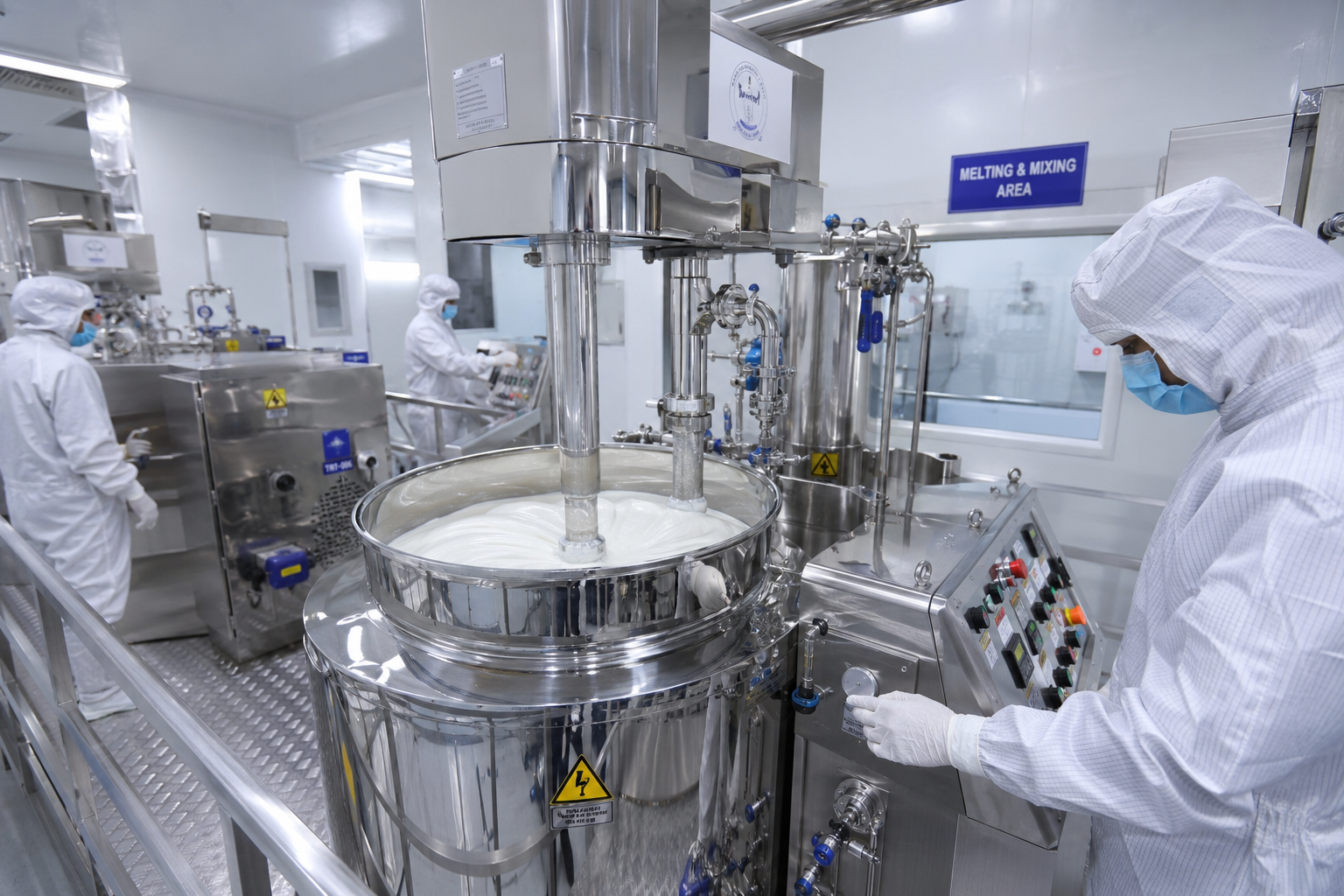
Quality control does not begin only after manufacturing is completed. In-process checks are important for maintaining consistency throughout production.
Common in-process checks include:
During raw material dispensing
-
Material identity verification.
-
Weighing accuracy.
-
Material status verification.
During base preparation
-
Temperature monitoring.
-
Melting condition.
-
Mixing condition.
During API incorporation
-
Addition sequence.
-
Mixing time.
-
Homogeneity.
-
Dispersion quality.
During mould filling
-
Filling quantity.
-
Filling temperature.
-
Mould condition.
-
Uniformity of filled cavities.
During cooling
-
Cooling conditions.
-
Solidification.
-
Physical appearance.
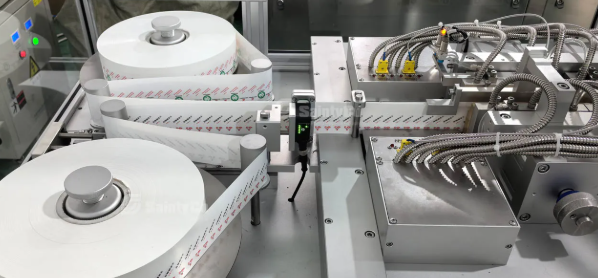
During packaging
-
Correct packaging material.
-
Sealing integrity.
-
Batch coding.
-
Printed information verification.
These checks should be documented in the applicable manufacturing and packaging records.
15. Common Quality Defects in Suppository Manufacturing
Manufacturing defects can affect the appearance, physical integrity and quality of finished suppositories.
|
Defect |
Possible cause |
|---|---|
|
Cracks |
Improper cooling or formulation characteristics |
|
Air bubbles |
Air entrapment during mixing or filling |
|
Uneven surface |
Inconsistent mould filling or cooling |
|
Deformation |
Inappropriate processing or storage temperature |
|
Weight variation |
Inconsistent filling quantity |
|
Content variation |
Inadequate API distribution |
|
Discolouration |
Ingredient instability or processing conditions |
|
Leakage |
Packaging or sealing defects |
The actual cause should be established through investigation rather than assumed from the visible defect alone.
Corrective and preventive actions should be documented through the applicable quality management system.
16. Instruments Used for Suppository Quality Control
Pharmaceutical quality control laboratories may use different instruments depending on the formulation and required testing.
Common equipment includes:
1. Analytical Balance: Used for accurate weighing and uniformity of mass testing.
2. HPLC System: Used for assay, content uniformity and related substances testing where appropriate.
3. UV-Visible Spectrophotometer: Used for suitable quantitative analytical methods.
4. Disintegration Testing Apparatus: Used when an applicable disintegration method is specified.
5. Melting Point or Softening Point Apparatus: Used to evaluate relevant thermal characteristics.
6. Karl Fischer Titrator: Used for water content determination where appropriate.
7. Microbiology Laboratory Equipment: Used for applicable microbiological testing.
8. Stability Chambers: Used to maintain controlled environmental conditions during stability studies.
9. Hardness or Breaking Strength Testing Equipment: Used for evaluating mechanical properties where required.
Instrument selection depends on the test method, product requirements and laboratory capabilities.
17. Regulatory and Pharmacopoeial Requirements
Suppository quality control testing should follow the applicable pharmacopoeial standards and approved product specifications.
Depending on the target market, relevant requirements may include:
-
Indian Pharmacopoeia (IP).
-
British Pharmacopoeia (BP).
-
United States Pharmacopeia (USP).
-
European Pharmacopoeia (Ph. Eur.).
-
Applicable national pharmaceutical regulations.
-
Relevant ICH guidelines for stability and analytical quality.
Not every test or acceptance criterion is identical across all products and pharmacopoeias.
Manufacturers and exporters should confirm the applicable requirements for the specific formulation and destination market.
18. Importance of Quality Control in Pharmaceutical Exports
Quality control is particularly important for pharmaceutical products intended for international markets.
Importers and regulatory authorities may request product-specific quality documentation before registration, importation or commercial supply.
Commonly requested documents include:
-
Finished Product Specification.
-
Certificate of Analysis.
-
Stability Study Report.
-
Manufacturing and Packaging Details.
-
GMP Certificate, where applicable.
-
Product Registration Documents.
-
Manufacturing Licence.
-
Other country-specific regulatory documents.
Global Entra Pharma supports pharmaceutical buyers across African and other international markets with product sourcing, third-party manufacturing coordination and export assistance through suitable manufacturing partners.
All supplies remain subject to product availability, local registration, import permissions and applicable regulatory requirements.
Frequently Asked Questions (FAQs)
1. What are the important quality control tests for suppositories?
Important tests may include appearance, uniformity of mass, assay, content uniformity, disintegration or dissolution, melting or softening characteristics, microbial quality and stability testing.
2. Is content uniformity testing required for all suppositories?
The requirement depends on the applicable pharmacopoeia, dosage form and approved product specification. It should be evaluated according to the relevant testing requirements.
3. Why is uniformity of mass important?
It helps evaluate whether individual suppositories have consistent weights and whether the mould-filling process is controlled.
4. Which instrument is used for suppository assay?
HPLC and UV-Visible spectrophotometry may be used depending on the API, formulation and validated analytical method.
5. What is the difference between melting time and disintegration time?
Melting or softening evaluates the physical transformation of certain bases, while disintegration evaluates the breakdown or loss of structure under specified test conditions. The two tests are not interchangeable.
6. Why is stability testing important for suppositories?
Stability testing helps establish how the formulation maintains its quality during storage and supports the proposed shelf life and storage conditions.
7. Are rectal and vaginal suppositories tested in the same way?
Some tests may overlap, but the required testing programme depends on the formulation, route of administration, applicable pharmacopoeia and approved specifications.
8. What documents are generally included in a suppository quality control file?
Documents may include specifications, analytical methods, validation or verification records, batch testing results, certificates of analysis and stability reports.
Suppository Manufacturing and Quality Documentation Support by Global Entra Pharma
Global Entra Pharma, based in Vadodara, Gujarat, India, supports pharmaceutical buyers, distributors and importers looking for suppository sourcing, third-party manufacturing coordination and export solutions.
Our enquiries cover rectal suppositories, vaginal suppositories, pessaries, ovules and other suitable pharmaceutical dosage forms through manufacturing partners.
We work with buyers to understand their product composition, strength, quality requirements, packaging specifications and target export markets.
Website: https://www.globalentrapharma.in