Suppository Formulation and Ingredients – Complete Guide to Pharmaceutical Composition
Introduction to Suppository Formulation
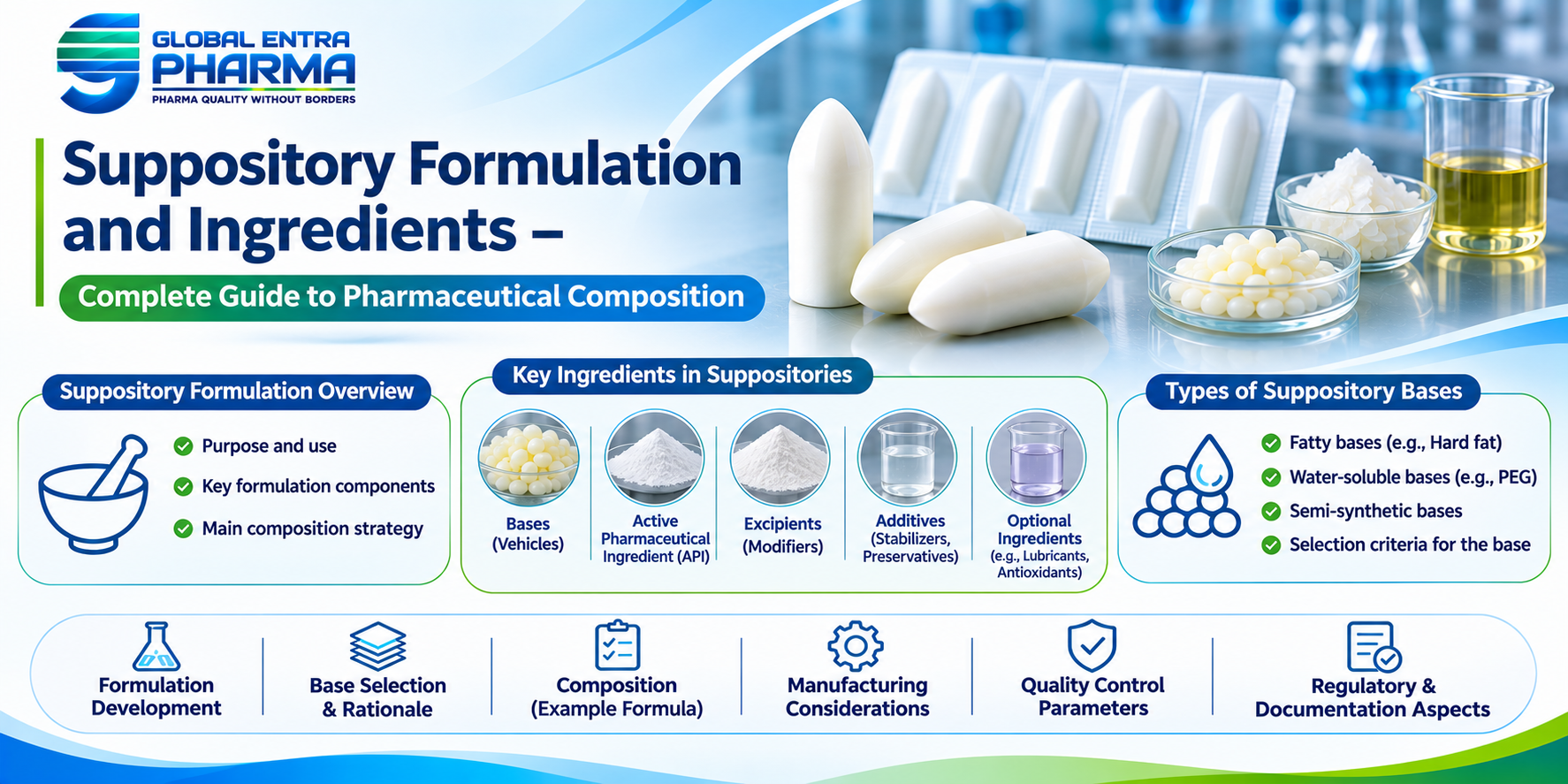
Suppositories are solid pharmaceutical dosage forms designed for insertion into the rectum or vagina. After administration, they may melt, soften, dissolve or disperse, depending on the type of base used, allowing the active pharmaceutical ingredient to become available for local or systemic delivery.
The formulation of a suppository requires careful selection of the active pharmaceutical ingredient (API), base and supporting excipients. These components must work together to provide suitable physical characteristics, drug distribution, stability and release performance.
Unlike conventional tablets and capsules, suppository formulations are strongly influenced by the physical properties of their bases. Factors such as melting characteristics, water solubility, viscosity, API solubility and compatibility can affect the final product.
Suppository formulations are broadly developed for two major applications:
-
Rectal suppositories: Designed for rectal administration.
-
Vaginal suppositories: Designed for vaginal administration and commonly supplied as vaginal ovules or pessaries, depending on their formulation and physical characteristics.
1. Main Components of a Suppository Formulation
A pharmaceutical suppository generally contains several components, each serving a specific purpose.
The main formulation components include:
-
Active pharmaceutical ingredient.
-
Suppository base.
-
Emulsifying agents.
-
Wetting agents.
-
Antioxidants.
-
Preservatives, where required.
-
Stabilising agents.
-
Other suitable pharmaceutical excipients.
The exact composition depends on the product's intended use, API properties, dosage strength, manufacturing process and regulatory requirements.
2. Active Pharmaceutical Ingredients Used in Suppositories
The active pharmaceutical ingredient is responsible for the intended therapeutic action of the suppository.
API selection depends on factors such as:
-
Intended therapeutic application.
-
Required dosage strength.
-
Solubility characteristics.
-
Physical and chemical stability.
-
Compatibility with the selected base.
-
Drug release requirements.
-
Applicable regulatory and pharmacopoeial standards.
A. APIs Used in Rectal Suppositories
Examples of ingredients used in rectal suppository formulations include:
Paracetamol: Used in suitable rectal formulations for pain and fever management.
Diclofenac Sodium: A non-steroidal anti-inflammatory drug used in appropriate formulations for pain and inflammation.
Glycerin: Used in glycerin suppositories for constipation management through its local action.
Bisacodyl: Used in suitable laxative suppository formulations.
Other APIs may also be formulated as rectal suppositories depending on their suitability and product development requirements.
B. APIs Used in Vaginal Suppositories and Ovules
Examples include:
Clotrimazole: An antifungal ingredient used in vaginal formulations for suitable fungal infections.
Metronidazole: An antimicrobial ingredient used in appropriate vaginal dosage forms.
Miconazole: An antifungal ingredient used in suitable vaginal formulations.
Progesterone: A hormonal ingredient used in specific vaginal drug delivery formulations.
The suitability of each API depends on its intended indication, formulation characteristics and applicable regulatory requirements.
3. Types of Suppository Bases
The suppository base forms the main structure of the finished dosage form. It carries the API and influences the product's physical properties and drug release behaviour.
The base should have suitable characteristics for manufacturing, storage and administration.
A. Hard Fat Base
Hard fat is a commonly used lipid-based suppository base.
Important characteristics include:
-
Solid consistency at normal storage conditions.
-
Melting or softening behaviour suitable for the intended product.
-
Good mouldability.
-
Compatibility with selected APIs.
-
Suitable physical stability.
Hard fat bases are commonly considered for rectal and vaginal formulations, subject to formulation suitability.
B. Cocoa Butter Base
Cocoa butter is a traditional fatty suppository base.
Its characteristics include:
-
Natural lipid composition.
-
Temperature-sensitive melting behaviour.
-
Ability to form solid suppositories.
-
Specific thermal properties that require controlled processing.
Cocoa butter can exhibit different crystal forms, which may influence its melting behaviour and physical stability. Appropriate processing controls are therefore important.
C. Polyethylene Glycol (PEG) Base
Polyethylene glycol bases are water-soluble suppository bases.
Different PEG grades may be combined to achieve the required consistency and dissolution characteristics.
Important properties include:
-
Water solubility.
-
Adjustable physical consistency.
-
Different molecular-weight grades.
-
Suitability for selected API formulations.
D. Glycerinated Gelatin Base
Glycerinated gelatin is a hydrophilic suppository base used in certain formulations, particularly vaginal preparations.
Its composition generally includes gelatin, glycerin and water in suitable proportions.
Important characteristics include:
-
Water-soluble behaviour.
-
Gradual dissolution.
-
Ability to form a structured dosage form.
-
Moisture-related storage considerations.
The base must be selected according to the intended product and its performance requirements.
4. Excipients Used in Suppository Formulations
Excipients are added to improve formulation properties, manufacturing performance, stability and drug release.
A. Emulsifying Agents
Emulsifying agents may be used when the formulation contains ingredients that require improved compatibility or dispersion between different phases.
Their functions may include:
-
Supporting uniform distribution.
-
Improving formulation consistency.
-
Helping stabilise certain dispersed systems.
-
Supporting reproducible manufacturing.
The choice depends on the API, base and intended formulation design.
B. Wetting Agents
Wetting agents may help improve the wetting and dispersion of poorly soluble or hydrophobic ingredients.
They can be useful when the API is incorporated as a suspended powder in the suppository base.
C. Antioxidants
Antioxidants may be included to reduce oxidative degradation of susceptible formulation components.
Their selection depends on the chemical properties of the API and base.
D. Preservatives
Preservatives may be required in certain formulations, particularly where the composition contains water or other ingredients that may support microbial growth.
Preservative selection should consider:
-
Compatibility with the API.
-
Compatibility with the base.
-
Microbiological effectiveness.
-
Safety for the intended route.
-
Regulatory acceptability.
Not every suppository formulation requires a preservative.
E. Stabilising Agents
Stabilising agents may be used to support the physical or chemical stability of the formulation.
Their purpose depends on the specific formulation and identified stability risks.
5. Factors Affecting Suppository Formulation Development
Formulation development is an important stage in producing a pharmaceutical suppository.
Several factors influence the selection of ingredients and manufacturing approach.
A. API Solubility
The solubility of the active ingredient in the selected base can affect drug distribution and release.
An API may be:
-
Soluble in the base.
-
Partially soluble in the base.
-
Insoluble and present as a suspension.
The incorporation method should be selected according to the API's physical and chemical properties.
B. Particle Size
For suspended APIs, particle size can influence:
-
Dispersion.
-
Sedimentation.
-
Content uniformity.
-
Formulation appearance.
-
Drug release characteristics.
Suitable particle-size control may be necessary during formulation development.
C. Base Compatibility
The API and excipients should be compatible with the selected suppository base.
Incompatibility may affect physical appearance, drug stability, content uniformity or release behaviour.
D. Melting and Softening Characteristics
The base should have suitable physical properties for manufacturing, storage and intended administration.
Excessively low softening characteristics may create handling and storage problems, while unsuitable melting or dissolution behaviour may affect product performance.
E. Drug Release Characteristics
The formulation should be evaluated to understand how the API becomes available from the dosage form.
Drug release can depend on API solubility, base type, excipient selection and the surrounding environment.
6. Rectal Suppository Formulation
Rectal suppositories are designed for administration through the rectum.
They may be developed for local or systemic drug delivery.
Common formulation considerations include:
-
API selection.
-
Suitable suppository base.
-
Required drug strength.
-
Physical consistency.
-
Drug distribution.
-
Melting, softening or dissolution behaviour.
-
Stability.
-
Packaging compatibility.
Examples of rectal suppository product categories include analgesic, antipyretic and laxative formulations.
The final formulation must be supported by suitable development studies and quality testing.
7. Vaginal Suppository and Ovule Formulation
Vaginal suppositories are designed for insertion into the vagina and are generally developed for local drug delivery.
Depending on their composition and physical form, these products may be described as vaginal suppositories, ovules or pessaries.
Common formulation considerations include:
-
API compatibility.
-
Suitable base selection.
-
Physical consistency.
-
Drug release.
-
Local tolerability.
-
Microbiological quality.
-
Moisture sensitivity.
-
Packaging compatibility.
Examples of vaginal formulation categories include antifungal, antibacterial and other locally administered pharmaceutical products.
The final composition should be established through appropriate formulation development and safety evaluation.
8. Suppository Formulation Development Process
The development of a suppository formulation generally follows a systematic approach.
Step 1: Define the product requirement
Identify the intended dosage form, route of administration, API, strength and target product characteristics.
Step 2: Select the suppository base
Evaluate suitable lipid-based or hydrophilic bases according to the API and intended product performance.
Step 3: Select suitable excipients
Identify any emulsifiers, wetting agents, antioxidants, preservatives or stabilisers required for the formulation.
Step 4: Conduct compatibility studies
Evaluate the compatibility of the API, base and excipients.
Step 5: Prepare trial formulations
Develop suitable trial batches and assess their physical and chemical characteristics.
Step 6: Evaluate drug distribution
Check whether the API is uniformly distributed throughout the formulation.
Step 7: Conduct quality testing
Perform appropriate physical, chemical and performance tests.
Step 8: Conduct stability studies
Evaluate the formulation under relevant stability conditions using suitable packaging.
Step 9: Finalise the formulation
Select the formulation that meets the approved development and quality requirements.
Step 10: Establish manufacturing parameters
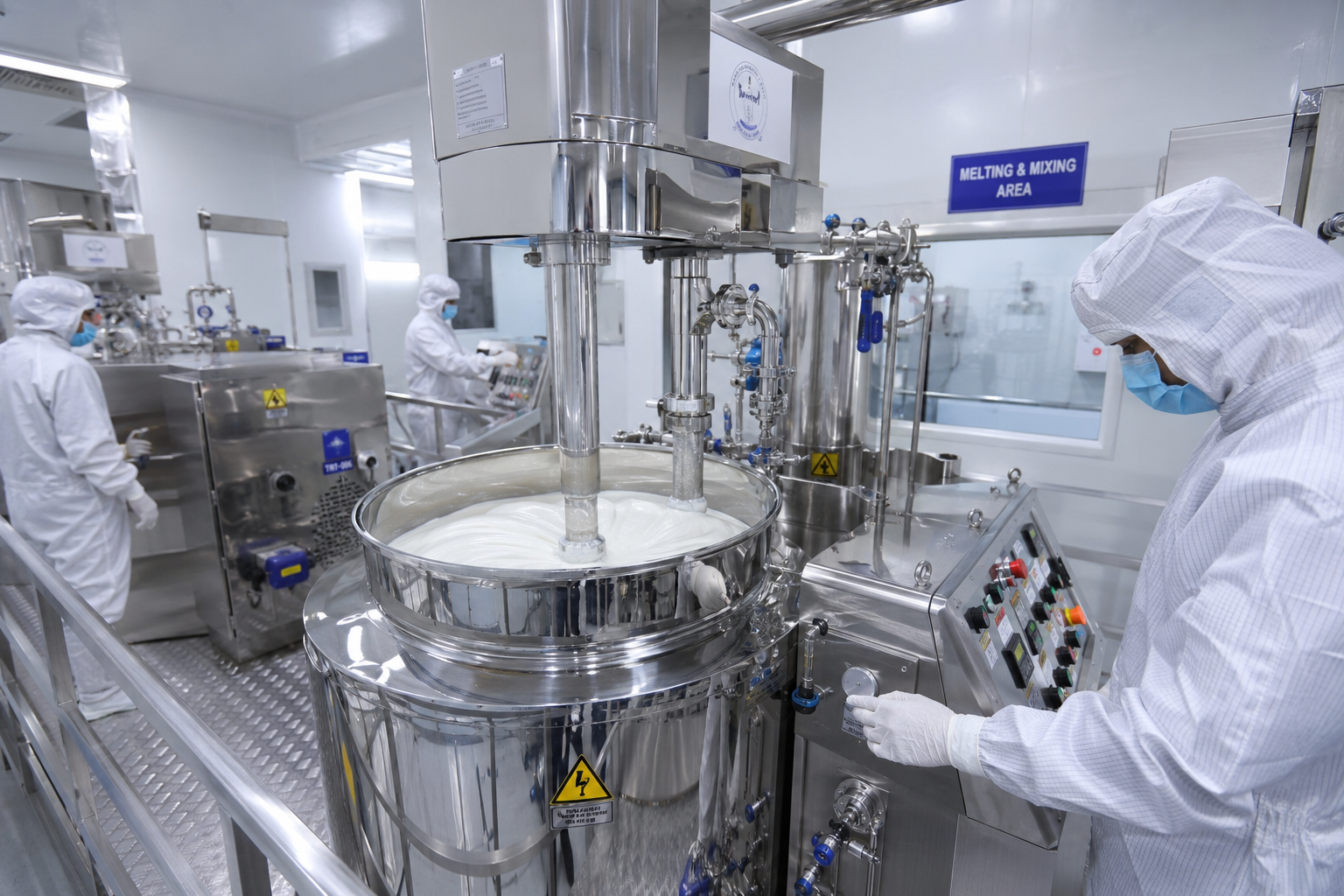
Define the suitable manufacturing process and establish the required controls before commercial production.
9. Common Formulation Problems and Their Causes
During formulation development, different problems may arise due to the characteristics of the API, base or manufacturing process.
|
Formulation problem |
Possible contributing factors |
|---|---|
|
API sedimentation |
Inadequate suspension stability or unsuitable viscosity |
|
Content variation |
Uneven API distribution |
|
Soft suppositories |
Unsuitable base characteristics or temperature exposure |
|
Brittle suppositories |
Base composition or physical instability |
|
Cracking |
Cooling conditions or formulation properties |
|
Discolouration |
Ingredient degradation or incompatibility |
|
Poor drug release |
API solubility or base-related factors |
|
Physical instability |
Inadequate formulation or packaging suitability |
The root cause should be identified through formulation investigation and appropriate laboratory testing.
10. Quality Evaluation of Suppository Formulations
After formulation development, the selected composition should undergo appropriate quality evaluation.
Common evaluation parameters include:
-
Appearance.
-
Uniformity of mass.
-
Assay.
-
Content uniformity, where required.
-
Disintegration or dissolution, where applicable.
-
Melting or softening characteristics.
-
Liquefaction time, where applicable.
-
Breaking strength, where relevant.
-
Microbiological quality.
-
Related substances.
-
Stability.
The required tests and acceptance criteria depend on the product, applicable pharmacopoeia and approved specifications.
11. Packaging Considerations for Suppository Formulations
Packaging plays an important role in maintaining the quality and stability of suppositories.
The packaging system should protect the formulation from environmental exposure and physical damage.
Common packaging options include:
-
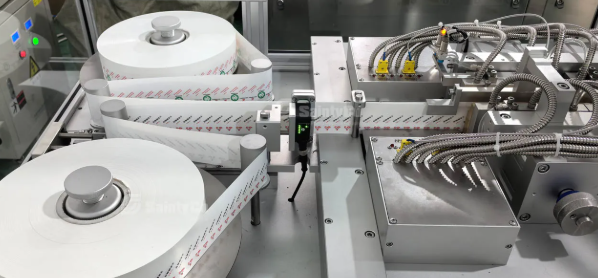
PVC blister packs.
-
PVC-aluminium blister packs.
-
Aluminium strip packs.
-
Other suitable pharmaceutical packaging materials.
Packaging selection should consider:
-
Moisture protection.
-
Temperature sensitivity.
-
Physical protection.
-
Compatibility with the formulation.
-
Sealing integrity.
-
Shelf-life requirements.
-
Destination-market labelling requirements.
Packaging compatibility should be evaluated as part of the product development and stability programme.
12. Documentation Required for Suppository Formulation Development
Appropriate documentation helps maintain traceability and supports the technical and regulatory evaluation of a pharmaceutical product.
Common documents include:
-
Formulation development report.
-
Master Formula Record (MFR).
-
Raw material specifications.
-
Raw material certificates of analysis.
-
Analytical method documents.
-
Finished product specifications.
-
Batch Manufacturing Record (BMR).
-
Batch Packaging Record (BPR).
-
Stability protocol and report.
-
Compatibility study reports.
-
Quality control test reports.
-
Process validation or qualification documents, where applicable.
The final documentation package depends on the product and target-market requirements.
13. Third-Party Suppository Formulation and Manufacturing
Pharmaceutical companies and international buyers may explore third-party manufacturing for suppositories when they require a suitable manufacturing partner.
A third-party manufacturing project generally involves:
-
Product composition finalisation.
-
API and excipient selection.
-
Strength confirmation.
-
Base selection.
-
Packaging development.
-
Quality specification review.
-
Manufacturing feasibility assessment.
-
Commercial quotation.
-
Regulatory documentation coordination.
Global Entra Pharma supports pharmaceutical buyers through product sourcing, third-party manufacturing coordination and export assistance for suitable pharmaceutical formulations.
Enquiries may include rectal suppositories, vaginal suppositories, pessaries, ovules and other pharmaceutical dosage forms through suitable manufacturing partners.
Product availability and manufacturing feasibility depend on the formulation, required strength, manufacturing partner capabilities and applicable regulatory requirements.
14. Factors Affecting Suppository Formulation Cost
The formulation cost depends on the composition and technical requirements of the product.
Major cost factors include:
-
API type and quantity.
-
API grade and sourcing cost.
-
Suppository base selection.
-
Excipient requirements.
-
Dosage strength.
-
Manufacturing batch size.
-
Packaging material.
-
Quality control requirements.
-
Stability study requirements.
-
Regulatory documentation.
-
Order quantity.
For an accurate quotation, buyers should provide the complete composition, product strength, pack size, estimated quantity and destination country.
Frequently Asked Questions (FAQs)
1. What are the main ingredients of a suppository?
A suppository generally contains an active pharmaceutical ingredient, a suitable suppository base and, where required, excipients such as emulsifiers, wetting agents, antioxidants, preservatives and stabilisers.
2. Which base is commonly used in suppositories?
Common bases include hard fat, cocoa butter, polyethylene glycol and glycerinated gelatin. Selection depends on the formulation and intended product characteristics.
3. What is the difference between lipid-based and water-soluble suppository bases?
Lipid-based bases generally melt or soften under suitable conditions, while water-soluble bases dissolve or disperse in aqueous environments.
4. Can the same base be used for rectal and vaginal suppositories?
Some bases may be suitable for both routes, but the final selection must consider the API, formulation characteristics, intended use, safety and product performance requirements.
5. Why is API solubility important in suppository formulation?
API solubility influences whether the ingredient is dissolved or suspended in the base and can affect drug distribution and release.
6. Are preservatives required in all suppositories?
No. Preservative requirements depend on the formulation, water content, microbiological risk and applicable product specifications.
7. What tests are required during suppository formulation development?
Testing may include appearance, uniformity of mass, assay, content uniformity, drug release, melting or softening characteristics, microbial quality and stability studies.
8. Can suppositories be manufactured through third-party manufacturing?
Yes. Suitable pharmaceutical manufacturers may undertake third-party manufacturing arrangements subject to applicable licensing, product specifications and regulatory requirements.
Suppository Formulation and Sourcing Support by Global Entra Pharma
Global Entra Pharma, based in Vadodara, Gujarat, India, supports pharmaceutical buyers, distributors, importers and businesses looking for pharmaceutical product sourcing, third-party manufacturing coordination and export solutions.
Our product enquiries include rectal suppositories, vaginal suppositories, pessaries, ovules, creams, ointments, tablets, capsules and other suitable dosage forms through manufacturing partners.
We coordinate with buyers to understand their composition, strength, packaging requirements, target markets and commercial quantities.
Website: https://www.globalentrapharma.in