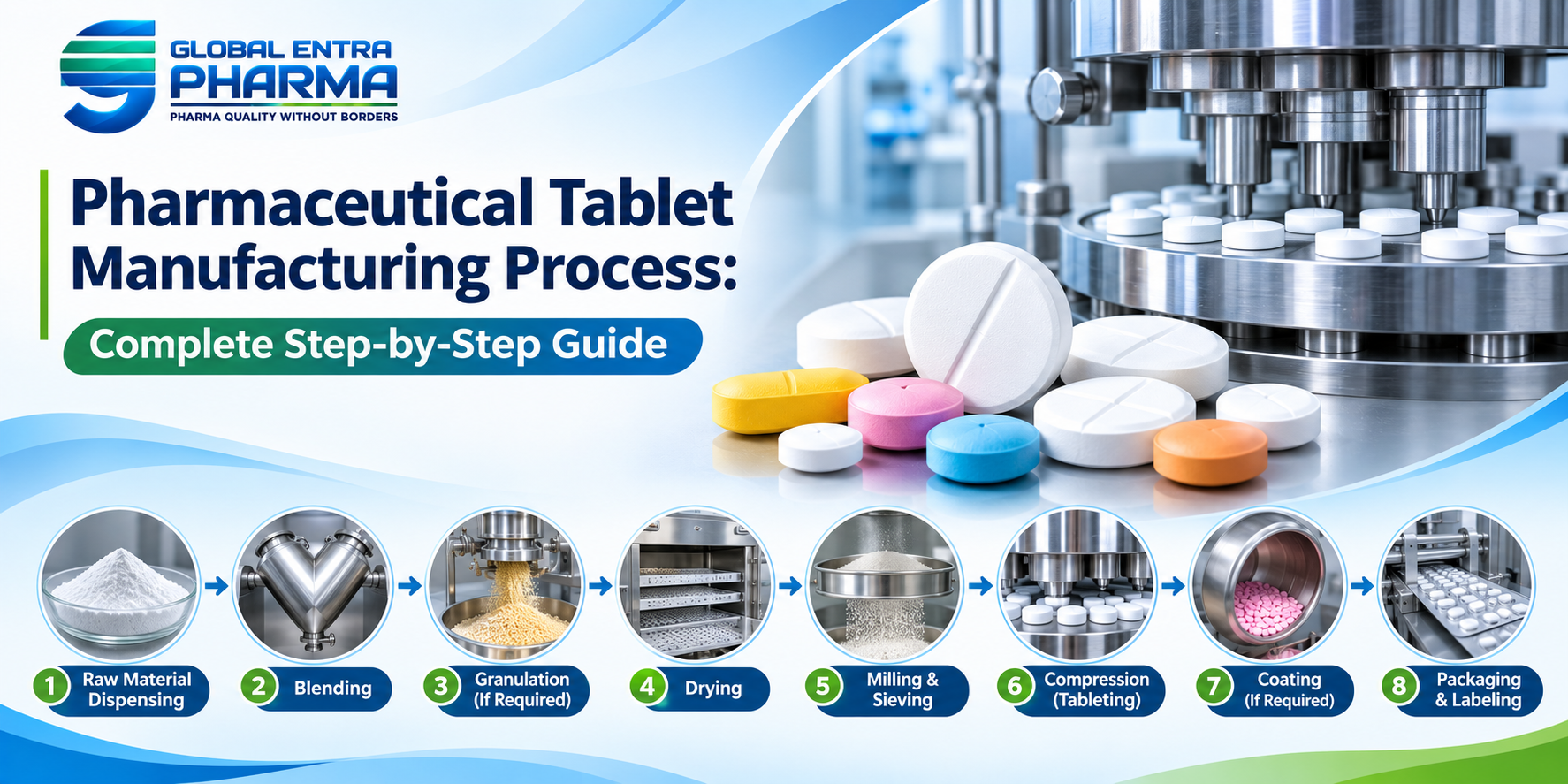
Pharmaceutical Tablet Manufacturing Process: Complete Step-by-Step Guide
Pharmaceutical tablets are among the most commonly manufactured solid oral dosage forms in the pharmaceutical industry. They are designed to provide accurate doses of active pharmaceutical ingredients (APIs) in a convenient, stable and easy-to-administer form.
The pharmaceutical tablet manufacturing process involves several controlled operations, starting from raw material dispensing and ending with finished-product packaging. Each manufacturing stage plays an important role in achieving the required product quality, uniformity, stability and performance.
The manufacturing process depends on the physical and chemical properties of the active pharmaceutical ingredient, excipient selection, formulation design and intended drug-release characteristics.
Global Entra Pharma focuses on pharmaceutical tablet sourcing, manufacturing coordination, third-party manufacturing and private-label supply solutions for pharmaceutical buyers in India and international markets.
1. What Is Pharmaceutical Tablet Manufacturing?
Pharmaceutical tablet manufacturing is the process of converting active pharmaceutical ingredients and suitable excipients into solid dosage forms through compression or other appropriate manufacturing technologies.
The manufacturing process is designed to achieve:
-
Uniform distribution of active pharmaceutical ingredients.
-
Consistent tablet weight.
-
Appropriate mechanical strength.
-
Suitable disintegration characteristics.
-
Required dissolution performance.
-
Consistent product quality.
-
Adequate stability throughout the shelf life.
Depending on the formulation, tablets may be manufactured using direct compression, wet granulation or dry granulation.
2. Raw Materials Used in Pharmaceutical Tablet Manufacturing
Tablet formulations generally contain active pharmaceutical ingredients and different excipients selected according to the formulation requirements.
A. Active Pharmaceutical Ingredients (API)
The active pharmaceutical ingredient is the substance responsible for the intended pharmacological activity of the medicine.
The API selection depends on the product composition, strength, therapeutic application and formulation requirements.
Examples include:
-
Paracetamol.
-
Metformin.
-
Amoxicillin.
-
Azithromycin.
-
Ciprofloxacin.
-
Pantoprazole.
-
Amlodipine.
-
Telmisartan.
-
Diclofenac Sodium.
-
Cetirizine.
B. Diluents or Fillers
Diluents are used to increase the bulk of a tablet formulation and support suitable manufacturing and compression characteristics.
Common examples include:
-
Microcrystalline Cellulose.
-
Lactose Monohydrate.
-
Dibasic Calcium Phosphate.
-
Mannitol.
-
Starch.
C. Binders
Binders help improve the cohesion of powder particles and support granule formation.
Examples include:
-
Povidone.
-
Starch Paste.
-
Hydroxypropyl Methylcellulose.
-
Pregelatinized Starch.
-
Other suitable pharmaceutical binders.
D. Disintegrants
Disintegrants help tablets break down into smaller particles after administration.
Common examples include:
-
Croscarmellose Sodium.
-
Sodium Starch Glycolate.
-
Crospovidone.
-
Starch.
E. Lubricants
Lubricants reduce friction between the tablet and manufacturing equipment during compression and ejection.
Examples include:
-
Magnesium Stearate.
-
Stearic Acid.
-
Sodium Stearyl Fumarate.
F. Glidants
Glidants improve powder flow characteristics during manufacturing.
Common examples include:
-
Colloidal Silicon Dioxide.
-
Talc.
G. Coating Materials
Coating materials are used when a tablet requires a protective, functional or aesthetic coating.
Examples include:
-
Hydroxypropyl Methylcellulose.
-
Polyethylene Glycol.
-
Suitable pharmaceutical coating polymers.
-
Approved pigments and colorants.
The selection of all excipients must be based on formulation compatibility, approved specifications and applicable pharmaceutical standards.
3. Different Methods of Pharmaceutical Tablet Manufacturing
There are three major approaches used in conventional pharmaceutical tablet manufacturing.
A. Wet Granulation Method
Wet granulation is a widely used manufacturing method in which powder particles are converted into granules using a suitable granulating liquid.
The process can improve powder flow, compressibility and content distribution, depending on the formulation.
Major stages include:
-
Raw material dispensing.
-
Sifting.
-
Dry mixing.
-
Binder solution preparation.
-
Wet granulation.
-
Drying.
-
Milling.
-
Final blending.
-
Lubrication.
-
Tablet compression.
Wet granulation is selected when the formulation requires improved granule characteristics or when direct compression is unsuitable.
B. Dry Granulation Method
Dry granulation is used to form granules without adding a liquid granulating solution.
The process may involve roller compaction or slugging.
The main stages include:
-
Raw material dispensing.
-
Sifting.
-
Initial blending.
-
Roller compaction or slugging.
-
Milling.
-
Final blending.
-
Lubrication.
-
Tablet compression.
Dry granulation may be appropriate for formulations containing moisture-sensitive ingredients or where liquid-based processing is unsuitable.
C. Direct Compression Method
Direct compression is a tablet manufacturing technique in which suitable powders are blended and compressed directly into tablets without a granulation stage.
The process generally includes:
-
Raw material dispensing.
-
Sifting.
-
Blending.
-
Lubrication.
-
Tablet compression.
-
Quality evaluation.
-
Packaging.
Direct compression requires suitable powder flow, compressibility and blend uniformity characteristics.
4. Step-by-Step Pharmaceutical Tablet Manufacturing Process
Step 1: Raw Material Procurement and Quality Approval
Raw materials are procured from approved suppliers according to established material specifications.
Before manufacturing, materials undergo appropriate sampling, testing and quality approval.
Important checks include:
-
Material identity.
-
Assay or potency, where applicable.
-
Purity.
-
Moisture content.
-
Physical characteristics.
-
Applicable impurity requirements.
-
Supplier qualification and documentation.
Only materials released by the quality unit should be used in production.
Step 2: Dispensing and Weighing
Active pharmaceutical ingredients and excipients are dispensed according to the approved master manufacturing formula.
Accurate weighing is essential to maintain the required composition and batch consistency.
Dispensing activities should be performed under appropriate environmental and procedural controls.
Step 3: Sifting
Sifting is performed to obtain suitable particle-size distribution and remove unwanted foreign particles.
It may also help break down lumps and support uniform blending.
The sieve size and equipment selection depend on the material characteristics and approved manufacturing procedure.
Step 4: Dry Mixing
The active pharmaceutical ingredient and selected excipients are mixed using suitable blending equipment.
The objective is to achieve an appropriate distribution of ingredients throughout the powder blend.
Common equipment includes:
-
Octagonal Blender.
-
Double Cone Blender.
-
Bin Blender.
-
Suitable Pharmaceutical Mixing Equipment.
Step 5: Granulation
Granulation is performed according to the selected manufacturing method.
In wet granulation, a suitable binder solution is added to the powder mixture to form wet granules.
In dry granulation, powder particles are compacted without using a liquid granulating solution.
Granulation parameters must be controlled to obtain suitable granule characteristics.
Step 6: Drying
In wet granulation, the wet granules are dried to achieve the specified moisture content.
Common drying equipment includes:
-
Fluid Bed Dryer.
-
Tray Dryer.
Drying parameters depend on the formulation, granule characteristics and validated manufacturing process.
Step 7: Milling and Sizing
Dried granules may undergo milling to obtain a suitable particle-size distribution.
The process helps improve consistency during subsequent blending and compression.
Common equipment includes:
-
Multi Mill.
-
Oscillating Granulator.
-
Suitable Pharmaceutical Sizing Equipment.
Step 8: Final Blending
The milled granules are blended with the required final-blend excipients.
This stage may include the addition of suitable disintegrants, glidants and other formulation ingredients.
Blending time and operating conditions should be established according to the formulation and manufacturing process.
Step 9: Lubrication
Lubricants are added to the final blend to reduce friction during tablet compression and ejection.
Lubrication parameters require appropriate control because excessive or insufficient lubrication may affect tablet properties.
Step 10: Tablet Compression
Tablet compression converts the final powder blend or granules into tablets using suitable compression equipment.
The compression machine contains punches and dies that determine the tablet shape and dimensions.
Common tablet compression equipment includes:
-
Single Punch Tablet Compression Machine.
-
Rotary Tablet Compression Machine.
-
High-Speed Rotary Tablet Press.
Important compression parameters include:
-
Tablet weight.
-
Hardness.
-
Thickness.
-
Compression force.
-
Machine speed.
-
Tablet appearance.
-
Disintegration characteristics.
In-process monitoring is performed according to approved manufacturing procedures.
Step 11: Tablet Dedusting and Metal Detection
After compression, tablets may pass through suitable dedusting equipment to remove loose powder from their surfaces.
Metal detection may be performed as part of the manufacturing contamination-control process.
The applicable equipment and controls depend on the manufacturing facility and product requirements.
Step 12: Tablet Coating
Some tablets undergo coating to improve appearance, taste masking, protection or drug-release characteristics.
Common coating processes include:
Film Coating: A thin polymer-based layer is applied to the tablet surface.
Sugar Coating: Multiple coating layers are applied using suitable sugar-based coating materials.
Enteric Coating: A specialized coating is applied to provide resistance to gastric conditions and release under appropriate intestinal conditions.
Common coating equipment includes perforated coating pans and other suitable pharmaceutical coating systems.
Step 13: Finished Tablet Quality Control
Finished tablets undergo appropriate quality-control testing according to approved product specifications.
Common tests include:
-
Appearance.
-
Average Weight.
-
Weight Variation.
-
Hardness.
-
Friability.
-
Disintegration.
-
Dissolution.
-
Assay.
-
Content Uniformity.
-
Related Substances.
-
Moisture Content, where applicable.
The testing requirements depend on the formulation and relevant pharmacopoeial standards.
Step 14: Pharmaceutical Tablet Packaging
After approval, tablets are transferred for packaging using suitable primary and secondary packaging materials.
Common packaging options include:
-
PVC-Aluminium Blisters.
-
Alu-Alu Blisters.
-
Aluminium Strip Packaging.
-
HDPE Bottles.
-
Printed Pharmaceutical Cartons.
-
Product Inserts and Leaflets.
Packaging materials must be suitable for the product and its intended storage conditions.
Step 15: Finished Product Release
The quality unit reviews the batch manufacturing documentation, packaging records, analytical results and other applicable records before finished-product release.
Only batches meeting the approved release requirements should be released for distribution.
5. Pharmaceutical Tablet Manufacturing Equipment
Different types of equipment are used during pharmaceutical tablet manufacturing.
Important equipment includes:
-
Vibro Sifter.
-
Octagonal Blender.
-
Double Cone Blender.
-
Rapid Mixer Granulator.
-
Fluid Bed Dryer.
-
Tray Dryer.
-
Multi Mill.
-
Oscillating Granulator.
-
Bin Blender.
-
Rotary Tablet Compression Machine.
-
Tablet Deduster.
-
Metal Detector.
-
Tablet Coating Machine.
-
Tablet Hardness Tester.
-
Friabilator.
-
Disintegration Test Apparatus.
-
Dissolution Test Apparatus.
-
Blister Packaging Machine.
-
Strip Packaging Machine.
The selection of equipment depends on the manufacturing scale, formulation, process design and applicable GMP requirements.
6. Critical Process Parameters in Tablet Manufacturing
Critical process parameters are manufacturing conditions that may affect product quality and process performance.
Important parameters include:
Granulation Parameters: Mixing time, binder addition, impeller speed and granulation endpoint.
Drying Parameters: Inlet temperature, product temperature, drying time and final moisture content.
Milling Parameters: Screen size, operating speed and granule characteristics.
Blending Parameters: Blending time, speed and blend uniformity.
Lubrication Parameters: Lubricant quantity and mixing time.
Compression Parameters: Compression force, machine speed, tablet weight and tablet thickness.
Coating Parameters: Inlet air temperature, product temperature, spray rate and coating weight gain.
These parameters should be established through formulation development, process validation and appropriate manufacturing controls.
7. Pharmaceutical Tablet Manufacturing Quality Requirements
Tablet manufacturing requires suitable quality management systems and documented manufacturing procedures.
Important quality requirements include:
-
Qualified manufacturing equipment.
-
Approved raw materials.
-
Trained production personnel.
-
Appropriate environmental controls.
-
Equipment calibration.
-
Cleaning procedures.
-
Process validation.
-
Analytical method validation.
-
In-process quality control.
-
Finished-product testing.
-
Batch documentation.
-
Deviation management.
-
Change control.
-
Stability studies.
Manufacturing operations should comply with applicable GMP requirements and relevant regulatory expectations.
8. Pharmaceutical Tablet Packaging Technologies
Tablet packaging is selected according to product stability, moisture sensitivity, light sensitivity and market requirements.
PVC-Aluminium Blister Packaging
A common pharmaceutical packaging configuration used for conventional tablet products.
Alu-Alu Blister Packaging
A high-barrier packaging option commonly considered for products requiring additional protection against moisture and environmental exposure.
Aluminium Strip Packaging
Suitable for different pharmaceutical tablet products depending on packaging specifications.
HDPE Bottle Packaging
Used for selected tablet products where bottle packaging is appropriate.
Export Carton Packaging
Secondary packaging may include customized printed cartons, batch information, expiry details, product inserts and country-specific labeling.
9. Third-Party Tablet Manufacturing in India
Third-party tablet manufacturing allows pharmaceutical companies and distributors to obtain suitable tablet formulations through authorized manufacturing partners.
Global Entra Pharma evaluates third-party tablet manufacturing enquiries based on product composition, required strength, manufacturing feasibility and buyer specifications.
Manufacturing enquiries may include:
-
Antibiotic Tablets.
-
Analgesic Tablets.
-
Antidiabetic Tablets.
-
Antihypertensive Tablets.
-
Gastrointestinal Tablets.
-
Antiallergic Tablets.
-
Cardiovascular Tablets.
-
Nutritional Tablets.
-
Combination Tablets.
-
Other pharmaceutical tablet formulations.
Buyers can provide product names, compositions, strengths, quantities, packaging requirements and target markets to initiate commercial discussions.
10. Pharmaceutical Tablet Manufacturing for Export Markets
Pharmaceutical tablet manufacturing and export projects require coordination between manufacturers, exporters and importing-country pharmaceutical authorities.
Global Entra Pharma focuses on pharmaceutical business enquiries from African and international markets.
Our target markets include:
African Markets: Ghana, Nigeria, Kenya, Uganda, Tanzania, Zambia, Zimbabwe, Malawi, Mozambique, Rwanda, Ethiopia, Cameroon, Senegal, South Africa, Botswana, Namibia, Sierra Leone, Liberia and Democratic Republic of the Congo.
Middle Eastern Markets: UAE, Jordan, Saudi Arabia, Iraq, Oman and other regional markets.
Other International Markets: Selected Asian, CIS and Latin American markets according to product availability and applicable regulatory requirements.
Product registration, import authorization, labeling and manufacturing documentation must be evaluated according to each destination country.
11. Pharmaceutical Tablet Manufacturing Documentation
Important documents associated with tablet manufacturing may include:
-
Master Formula Record (MFR).
-
Batch Manufacturing Record (BMR).
-
Batch Packaging Record (BPR).
-
Standard Operating Procedures (SOPs).
-
Raw Material Specifications.
-
Finished Product Specifications.
-
Standard Testing Procedures.
-
Analytical Method Validation.
-
Process Validation Reports.
-
Cleaning Validation Documentation.
-
Equipment Qualification Records.
-
Calibration Records.
-
Stability Study Reports.
-
Certificate of Analysis.
-
Deviation Reports.
-
Change Control Records.
Documentation must be maintained according to applicable GMP and regulatory requirements.
12. Why Choose Global Entra Pharma for Tablet Manufacturing Solutions?
Global Entra Pharma focuses on pharmaceutical tablet sourcing, third-party manufacturing coordination, private-label manufacturing and export-oriented pharmaceutical supply.
Our business services include:
Multiple Tablet Formulations: Enquiries across antibiotic, analgesic, gastrointestinal, cardiovascular, antidiabetic and other therapeutic categories.
Third-Party Manufacturing: Evaluation of suitable manufacturing partners for different tablet products.
Private Label Manufacturing: Customized branding and packaging coordination.
Product Sourcing: Evaluation of product specifications and commercial requirements.
Documentation Coordination: Discussion of applicable product and manufacturing documentation.
International Export Coordination: Commercial quotations, packaging discussions and shipment coordination.
We aim to support pharmaceutical importers, distributors and international buyers with suitable pharmaceutical manufacturing and supply arrangements.
13. Frequently Asked Questions About Pharmaceutical Tablet Manufacturing
1. What are the main methods of pharmaceutical tablet manufacturing?
The three major conventional methods are wet granulation, dry granulation and direct compression.
2. What is wet granulation in tablet manufacturing?
Wet granulation involves mixing powder ingredients with a suitable granulating liquid to form granules that are subsequently dried, sized and compressed into tablets.
3. What is dry granulation?
Dry granulation forms granules through compaction without adding a liquid granulating solution.
4. What is direct compression?
Direct compression is a process in which suitable powder blends are compressed directly into tablets without a separate granulation stage.
5. Which machine is used for tablet compression?
Rotary tablet compression machines and single-punch tablet compression machines are commonly used depending on manufacturing requirements.
6. Why is granulation important in tablet manufacturing?
Granulation can improve powder flow, compressibility and blend handling characteristics, depending on the formulation.
7. What is the purpose of tablet coating?
Tablet coating can improve appearance, mask taste, protect the formulation or provide specific drug-release characteristics.
8. What is the difference between wet granulation and dry granulation?
Wet granulation uses a liquid binder solution, whereas dry granulation forms granules through mechanical compaction without liquid addition.
9. Which tests are performed after tablet compression?
Common tests include appearance, weight variation, hardness, thickness, friability and other applicable in-process quality checks.
10. Can pharmaceutical tablets be manufactured through third-party manufacturing?
Yes. Suitable pharmaceutical tablet formulations can be evaluated for third-party manufacturing through authorized manufacturing partners, depending on product and regulatory requirements.
11. What documents are required for pharmaceutical tablet manufacturing?
Documents may include MFR, BMR, BPR, SOPs, specifications, validation reports, analytical reports and other applicable GMP documentation.
12. Can pharmaceutical tablets be manufactured for international export?
Yes. Pharmaceutical tablet products can be manufactured and exported subject to applicable manufacturing authorization, product registration and importing-country requirements.
14. Contact Global Entra Pharma for Pharmaceutical Tablet Manufacturing and Export
Are you looking for pharmaceutical tablet manufacturing, third-party manufacturing or private-label supply solutions from India?
Global Entra Pharma welcomes enquiries from pharmaceutical importers, distributors, wholesalers and international pharmaceutical companies.
Share your product name, composition, strength, required quantity, packaging configuration and destination country to discuss manufacturing feasibility and commercial quotations.
Global Entra Pharma
Vadodara, Gujarat, India
Website: https://www.globalentrapharma.in
Email: sales@globalentrapharma.in
WhatsApp: +91 6351494384
Global Entra Pharma – Pharmaceutical Tablet Sourcing, Manufacturing Coordination and Export Solutions for African and International Markets.